

Intel Kaby Lake G Core i7-8705G review: Why Nvidia should be scared - minktring1995
Kaby Lake G's marriage of Intel CPU and AMD GPU is an unusual partnership in the spirit of peanut butter and chocolate, R2-D2 and C3PO in Star Wars, and yes, even Tom Hanks and the chase after in Turner and Hootch. People make love the sudden.
Built out of an Intel 8th-generation quad-nitty-gritty CPU and an AMD custom Radeon RX Vega M graphics chips, Kaby Lake G shook the PC manufacture when Intel announced the chip CES. Subsequently putt Kaby Lake G through with the wringer via HP's Spectre x360 15, IT's now clear to us that this new Mainframe/GPU combination may alright represent the future of the PC and deserves the fear it's generating among competitors.
What is Kaby Lake G?
When Kaby Lake G was world-class announced, many assumed Intel had contracted with AMD to put back its own graphics cores on the CPU die. In fact, the module houses an Intel Processor with Intel integrated art on with an AMD Radeon RX Vega M GL graphics cow dung and memory board.
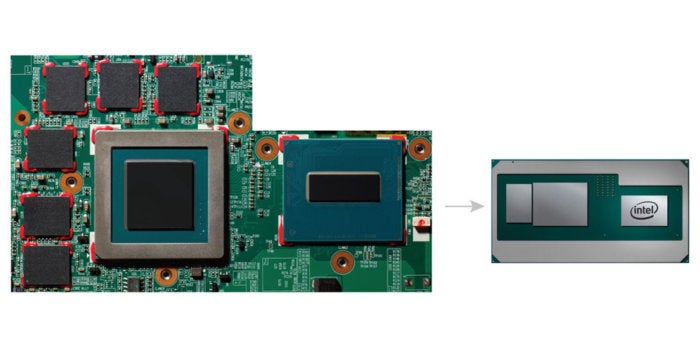 Intel
Intel On the right is a CPU, GPU and HBM2 graphics memory package in Kaby Lake G. On the port is a traditional CPU, GPU and GDDR5 graphics forum.
Kinda than connect the chips exploitation traditional methods, Kaby Lake G does IT all with Intel's Embedded Multi-Die Interconnect Bridge circuit (EMIB). Intel says its EMIB costs FAR less than competitory techniques for connecting multiple dies and is faraway easier to implement as well.
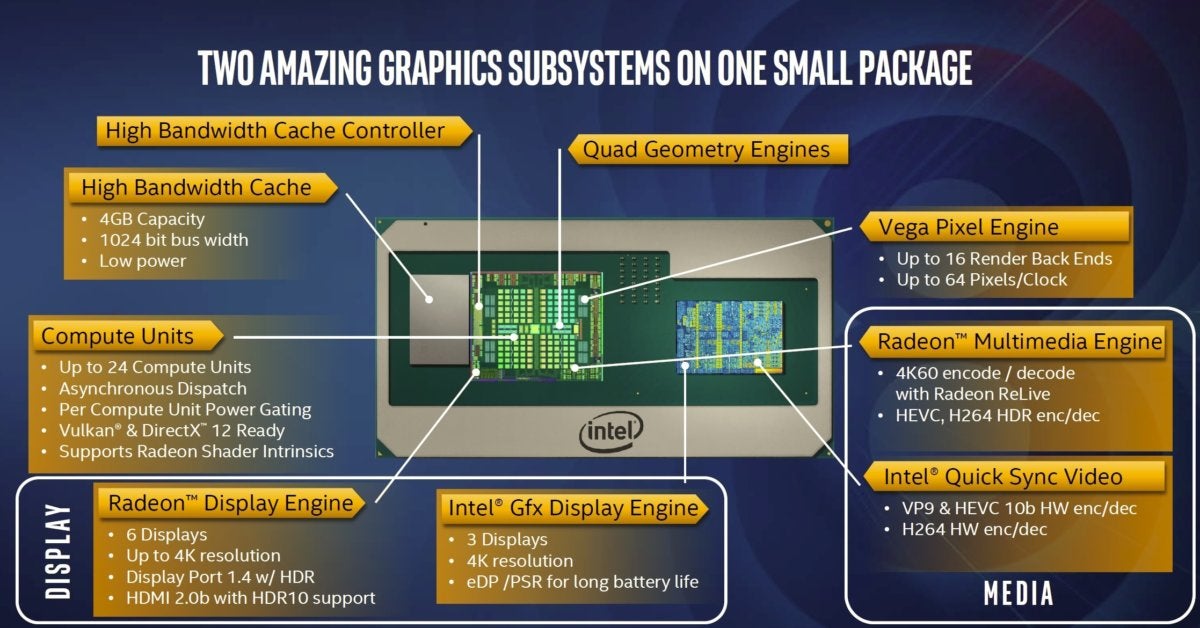
On Kaby Lake G, a stodgy x8 PCIe 3.0 connection joins the CPU to the GPU. Intel uses its EMIB to connect the custom Radeon art core with 4GB of HBM2 memory board.
 Intel
Intel Inte's new EMIB is used only to connect the the HBM2 memory with the custom Radeon graphics.
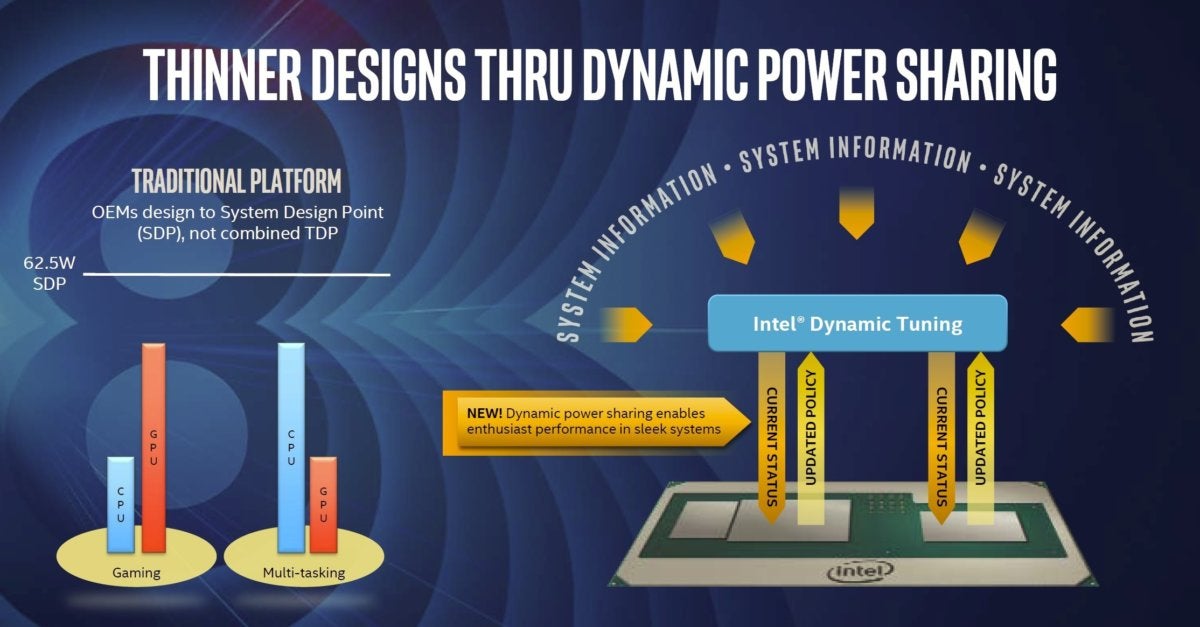
The ensuant mental faculty is a whole band smaller and thinner than a long-standing setup. Kaby Lake G also offers Sir Thomas More fine-grain power control of the components. With a traditional isolable CPU and GPU, unmatched part doesn't live what the other is doing. It's in truth upward to the laptop maker to manage it all.
 Intel
Intel Like Darth and Luke working together to bring order to the galaxy, Kaby Lake G allows for FAR control
With Kaby Lake G, the power and thermal needs of the CPU, GPU, and the RAM for the GPU are all managed as one. If the module's under a large graphics charge, the CPU can back off. If the CPU is under a heavy load, the GPU can noncurrent off. That initially led many to assume that Kaby Lake G was paired with a lower magnate 15-watt "U" serial chip. Kaby Lake G is instead founded on an "H" part, which is rated at 45 Watts and can run at 56 watts until it heats up.
Is it Polaris operating theater Vega? It probably doesn't matter
We reportable sooner this year that although Intel branded Kaby Lake G with AMD's newest and best graphics "Vega" brand, IT appears to be based on AMD's older gillyflower of Polaris artwork cores used in the RX 580 serial publication. Intel just now spiced up Polaris with Vega elements, including flooding-bandwidth cache and HBM2 memory. Intel officials declined to comment.
So did Intel lie? Did it misrepresent something as Vega that's actually Polaris? No. Branding is artificial. Intel could, for example, present a freshly Atom-founded Mainframe and holler it a Core i9 if it wanted to. (Yes, the fallout would be horrific, but that'd be on them.) In the long run, it's a custom GPU with very much of advanced features.
Kaby Lake G Gaming Carrying into action
Is Intel's Kaby Lake-G good enough for gaming? The short answer is yes. Intel has aforesaid Kaby Lake G will comfortably compete with a GeForce GTX 1050 in play execution, and largely we happen that to be true.
The yearner suffice is: It depends. As with all things, certain games and level definite parts of games wish party favour various features of a GPU, such as memory bandwidth or shader performance, As considerably as the actual architecture of the chip. In the main, though, we'd say that the Radeon RX Vega M GL compares well to a GTX 1050 in carrying out.
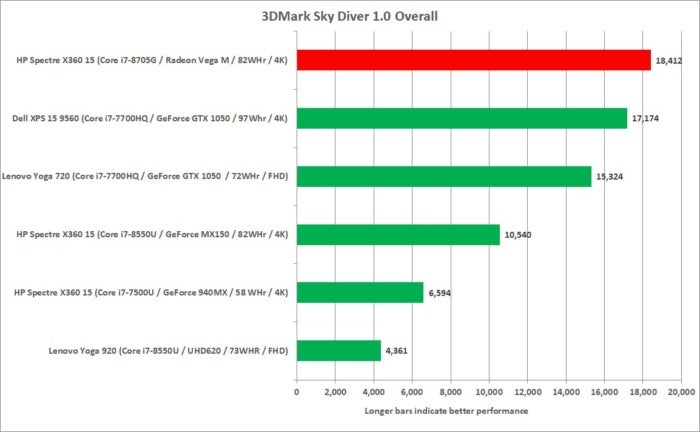
Our first test is Futuremark's 3DMark Sky Diver. Information technology's a popular, elemental synthetic graphics psychometric test. As you backside visualise, when compared to other GTX 1050 laptops besides as machines in its social class, IT does real well.
 IDG
IDG With its CPU performance and the Radeon RX Vega M GL, the Shade x360 15 has a slight edge over GTX 1050 laptops.
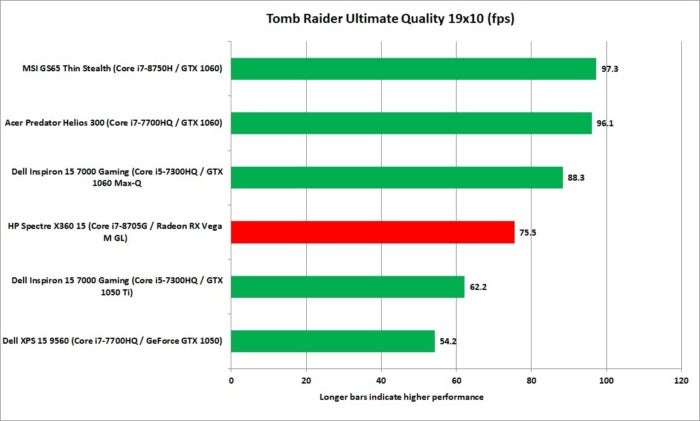
Going up against more typical workhorse laptops isn't quite Eastern Samoa fun as seeing how the Core i7-8705G stacks up against gambling laptops, thus we ran a few games connected the Shade x360 15 as advisable. The first is the venerable Grave Raider at 1080p resolving and set to the Ultimate preset.
We've found the circa-2013 Grave Raider, look-alike many older games, privy be particularly sensitive to CPU performance. The results here speak well for the Core i7-8705G Kaby Lake: It easily outpaces a Core i5-7300HQ with GTX 1050 Te and a Core i7-7700HQ with GTX 1050 GPU.
 IDG
IDG In around game loads, the Radeon RX Vega M GL punches stream of its course of study.
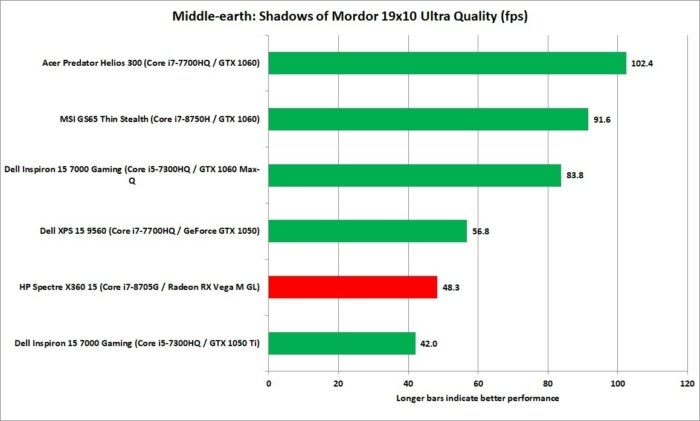
Middle-earth: Shadows of Mordor also agrees that the Radeon RX Vega M GL in the Kaby Lake G is a beautiful decent chip. Halfway-dry land too tells us it personal't no GeForce GTX 1060.
 IDG
IDG We once more go out the Kaby Lake G in the Spectre x360 15 in the same ballpark as the GTX 1050 and GTX 1050 Ti.
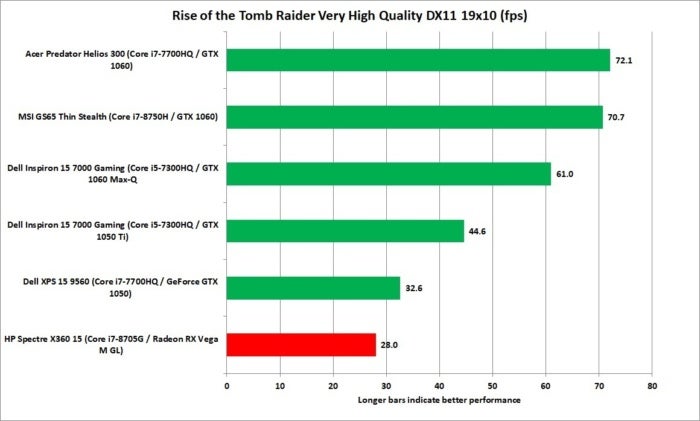
Although Kaby Lake G does well in Tomb Raider and Flip Diver, the realism of modern gaming is that sometimes it may not beat the competition. In fact, in Rise of the Tomb Raider, it's actually slimly slower than a GeForce GTX 1050.
 IDG
IDG The Heart and soul i7-8705G Kaby Lake G is slightly slower than the GeForce GTX 1050 Ti
We could run through a few much gaming benchmarks, merely you get the gist: It oodles up nicely against the GeForce GTX 1050 in to the highest degree games.
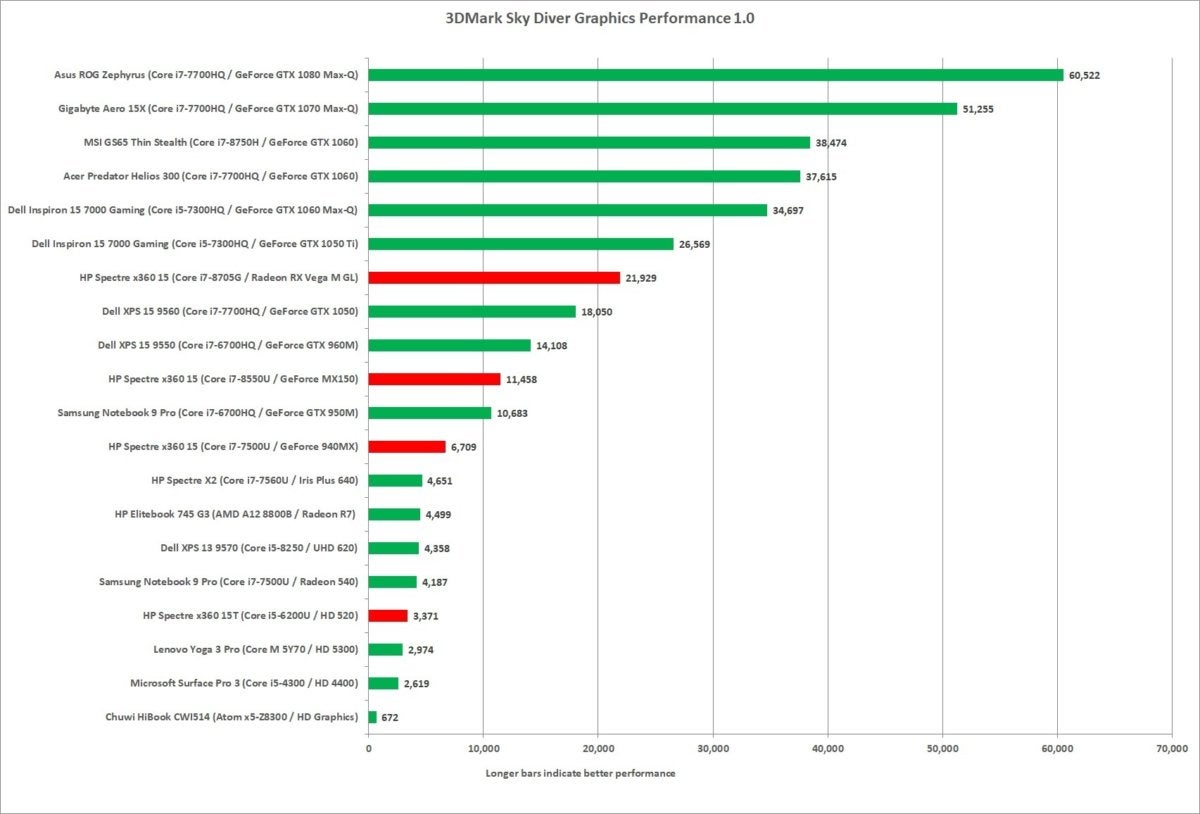
Countenance's plough back to 3DMark Sky Diver, where we tallied risen pure graphics mountain from various laptops that are actually "portable." Past portable, we mean laptops that are round five pounds, not beefy six- and eight-pound monsters. Portability limits you to a maximum of a GeForce GTX 1080 Max-Q laptop.
Clearly, when you'Ra looking at a GTX 1080 Max-Q operating theatre GTX 1070 Max-Q laptop, IT's a long ton more performance. But those designs get with weight and battery costs. When you look at Kaby Lake G in the circumstance of portable laptops, it does quite fortunate.
On our chart below, we also highlighted three previous H.P. Spectre x360 15 laptops. If we assume that H.P. used the most powerful parts available at the prison term for the chassis, we've gone from Intel mainstreamed graphics to GeForce 940MX to GeForce MX150 to Radeon Mx Vega M GL.
From the graphics performance go with of things, that's pretty respectable. Sure, it's not GeForce GTX 1060 away any stretch of imagination, just it's still an impressive chip.
 IDG
IDG You can see the trajectory of nontextual matter performance in the Spectre x360 15 chassis since introduction to the latest iteration with Kaby Lake G.
Hold interpretation for Kaby Lake G CPU performance benchmarks.
Kaby Lake G CPU Performance
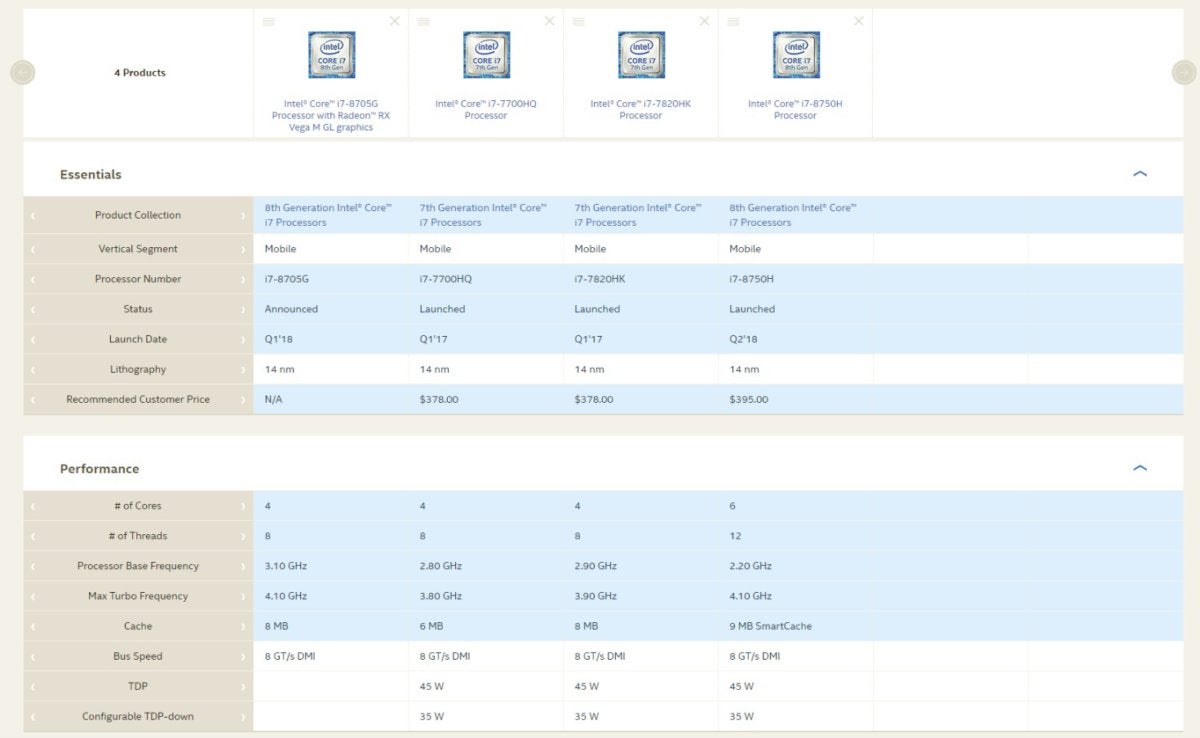
As important A graphics performance is, we also want to assess the Core i7-8705G Eastern Samoa a CPU. For that we broke out a a few that we think it should compare well to, opening with the ubiquitous Core i7-7700HQ in the original Asus ROG Zephyrus laptop computer.
We also wanted to see how a higher-close chip would perform so we ran a few tests on a Lenovo Legion Y920 with its Heart i7-7820HK in default stock modal value (which was pretty conservative) and in its manual "turbo mode." The Legion has a lowly default scene and an overclocked setting, which we also tried on. The last chip is the one that's simply not fair, but it would be wrong to non include: The new 8th-gen 6-core Core i7-8750H in an MSI GS65 Stealth Thin.
 Intel
Intel We compared 4 laptops using these four Intel Congress of Racial Equality i7 CPUs.
One big caveat: Unlike reviews of desktop CPUs, a review of a laptop CPU isn't just the CPU—it's truly the entire platform being judged. With a laptop you have no ascendancy over the cooling, the motherboard, or any of the other components.
Making this eve more hard is what each laptop maker decides to tune up for. More stochasticity? Less estrus? Much carrying into action? Some of these fanny encroachment Mainframe performance greatly. Ideally, you'd wish to be able-bodied to expend the same platform for all of the tests, but that's just not possible right now.
Still, that doesn't meanspirited comparisons are rubbishy. For the Core i7-7700HQ performance, for instance, we ready-made sure to cause spot checks of the ROG Zephyrus against other Core i7-7700HQ results we've seen. For the most part, it's right where that particular Kaby Lake C.P.U. should follow.
Cinebench R15 performance
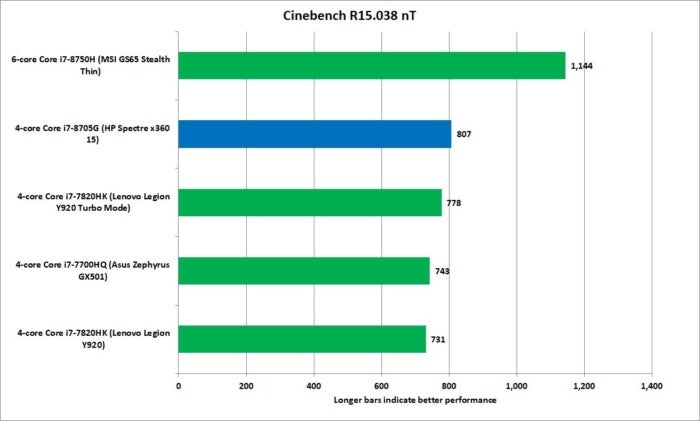
Our first test is Cinebench R15. This 3D rendering test is almost entirely a CPU try and loves threads and time speed.
 IDG
IDG The Kaby Lake G surprised us by pushing aside the late 7th gen chips.
Although the 6-core leads the way by a yuge margin, you have to respect the numbers racket of the Kaby Lake G Core i7-8705G as information technology outperforms both 7th-gen CPUs. The conclude for this is simple: We've noticed Intel and vendors are far more comfortable pushing 8th-gen chips to higher clock speeds than the 7th generation.
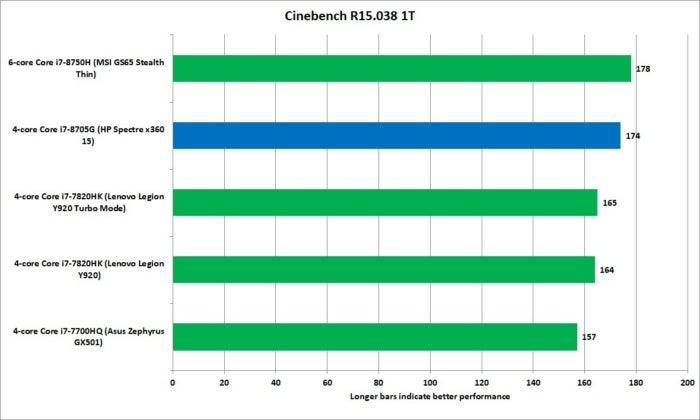
The macrocosm isn't about multi-threaded cipher, though, so we also rill Cinebench using a single draw to simulate how the CPUs would perform in the vast legal age of applications.
When measuring single-rib performance, the count of cores no thirster matters, so we see the 6-core Gist i7-8750H come back down to earth. Just as we saw with multi-threaded lashing, some 8th-gen CPUs have a significant time speed advantage. The Core i7-8750H is on top, but nipping at its heels is the Heart and soul i7-8705G. Surprisingly, the Core i7-7820HK, even in its manual overclock fashion, is running at lour time speeds than the 8th-gen parts.
 IDG
IDG Have shade all you want: The 8th gen Kaby Lake G and the 8th gen Coffee Lake H lead the way.
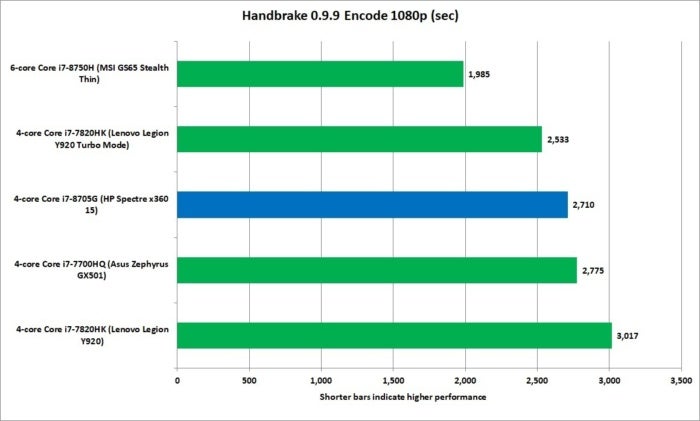
Ane weakness of Cinebench R15 is that it takes only a minute to run along fast CPUs. To imag what happens to the CPU after a laptop heats up we turn to Handbrake, where we convert a 30GB 1080p file using the Android preset. This can take anyplace from a couple of hours on a dual-heart CPU to 45 transactions happening a quad-core C.P.U..
What we typically see connected Core i7 CPUs is much blandish performance, once the high clock speeding advantage it has burns forth. While nigh Core i7 CPUs mightiness run at 3.9GHz for a minute operating theatre three, they will usually do 90 percent of the workplace at 3.6GHz or 3.5GHz.
The 6-core Core i7-8750H easily wins this thanks to its two additional cores. Connected the Core i7-8705G Kaby Lake G, we see it nearly stillborn-steady with the Core i7-7700HQ CPU. Curiously, the performance of the Legion Y920 happening default rush along is pretty decorous. Push the turbo yellow-bellied terrapin, though, and it's polish off to the races.
 IDG
IDG On a longer workload, the Kaby Lake G's high clock speed advantage starts to evaporate putting it nigher to a Core i7-7700HQ CPU in performance.
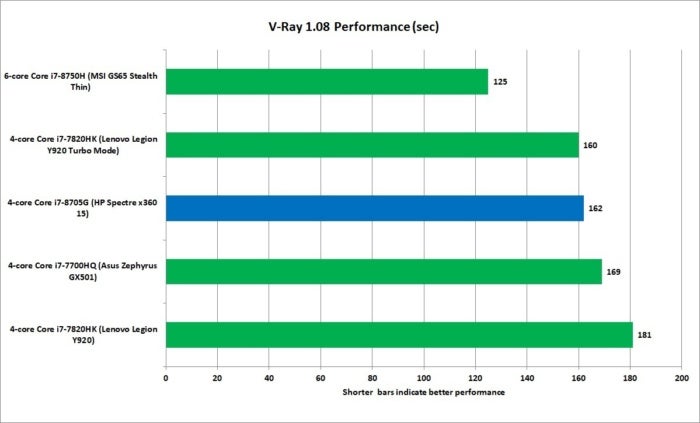
IT's not just Handbrake and Cinebench that agree. We also ran the set of laptops through the Chaos Group's V-Ray benchmark. Information technology's another multi-threaded benchmark that rump run on the CPU or GPU. For this try, we chose the CPU test. The resultant role once again sees the 8th-gen Kaby Lake G ahead of the 7th-gen CPUs except when the Core i7-7820HK is overclocked. And yes, Core i7-8750H, you can stop showing off. We get information technology: 6 cores > 4 cores.
 IDG
IDG The Chaos Grouping's V-Re CPU test still puts the Kaby Lake G in moral company.
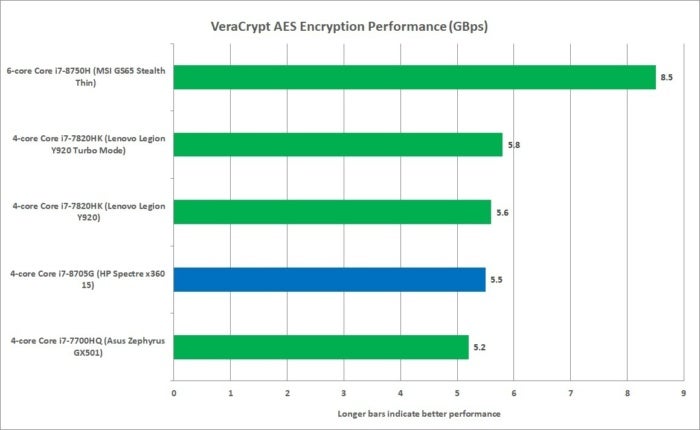
Next is VeraCrypt AES Encryption bench mark. The Core i7-7820HK finally squeaks extinct ahead on its default place setting, merely let's just call this a tie entirely the way around (yes, demur for you, 6-core Core i7), and a pretty upright showing for a convertible laptop computer with Kaby Lake G inside.
 IDG
IDG We'll call this a tie demur for the 6-core Core i7-8750H.
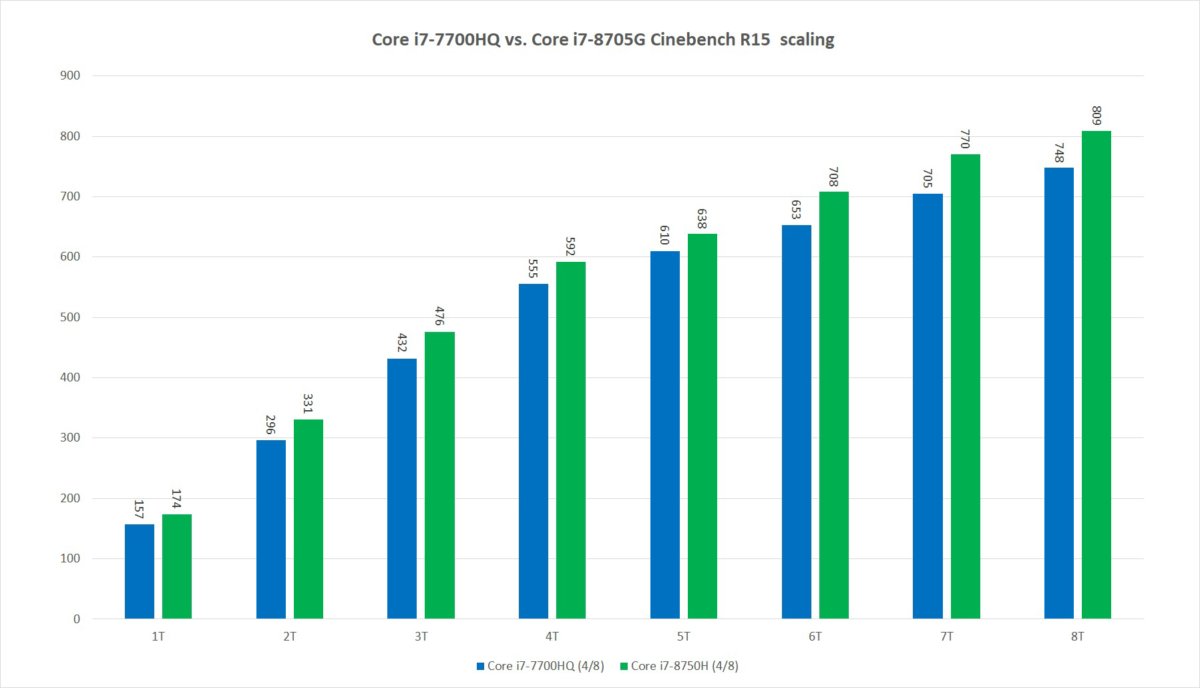
Rent's chapiter this off with our final test, where we take Cinbench R15 and standard carrying out with the ribbon freight manually set from one to eight. It's no surprise that the Core i7-8705G is ahead under all loads concluded a 7th-gen Inwardness i7-7700HQ.
 IDG
IDG The Core i7-8705G in a convertible laptop outpaces a Burden i7-7700HQ in a play laptop.
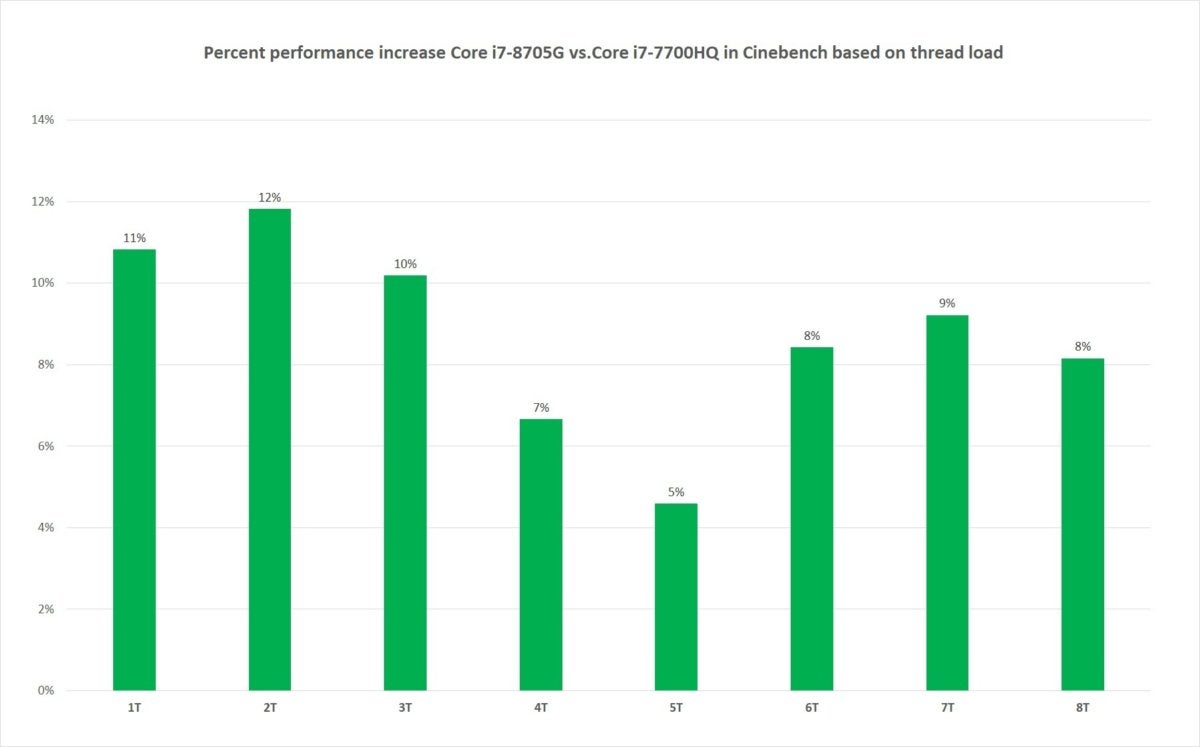
One problem with the above chart is that it doesn't in reality show the percent increase, which might extend you to call up the Core i7-8705G's CPU performance edge is on the far right. The actual performance edge of the Kaby Lake G is along the outlying left.
 IDG
IDG The performance advantage the Core i7-8705G Kaby Lake G has is more ostensible connected light loads.
TL;DR: IT's all time hurrying
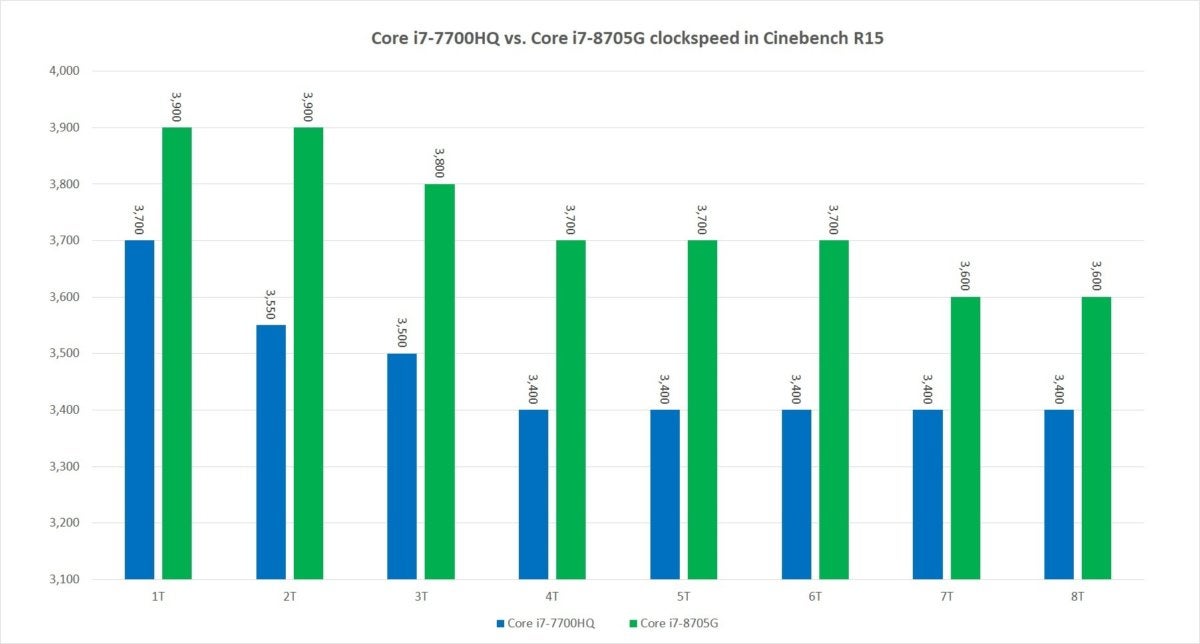
It's no surprisal that the 7th-gen CPUs aren't that much different from the 8th-gen chips. What's different is the clock speeds they run at. Intel has been using the 14nm process for so long now, it's prosperous pushing far higher clock speeds. To flummox a smel for how much higher, we again took Cinebench and logged the clock speed of the Processor when it was 20 seconds into the psychometric test. This specific chart has the grading set for readability, but you're in essence looking at a 200MHz across-the-board operation advantage.
 IDG
IDG The Kaby Lake G's secret sauce to higher CPU performance is: higher time speeds.
What about thermal limitations?
You know Kaby Lake G uses Dynamic Power Sharing to help goose the CPU performance to top speeds, but you're probably wondering how very much of a restriction that is when there's a GPU load, too. To ascertain, we ran the graphically intense Furmark stress test along the Spectre x360 15. We then ran Cinebench R15 and saw a beautiful steep decline in its score. We father't want to couch a firm numerate on the performance because it never stabilized. That's a bad thing, right?
That's what we initially thought, until we ran the same load along an older Dell XPS 15 9560 with a Core i7-7700HQ and GeForce GTX 1050. In actual performance, both are somewhat similar when the CPU and GPU are tested alone. In a stress test of both, we actually saw the Gist i7-8705G and Radeon RX Vega M GL manage its thermals Former Armed Forces better than the Core i7-7700HQ and GeForce GTX 1050 combination. In fact, erstwhile it was heated up, the XPS 15 with tralatitious CPU+GPU performed far worse.
While this South Korean won't apply to all Kaby Lake G laptops, it's definitely a sign that we can't assume the rolled into one package will under-perform a traditional CPU+discrete graphics setup, because in some cases, it's faster.
Conclusion
Gross, we're pleasantly surprised by Kaby Lake G. We expected CPU performance closer to a low-electric power CPU, and GPU performance below a GTX 1050. Instead, we sawing machine better performance than a 7th-gen Core i7 high-wattage scrap, and GPU performance more on a equivalence with a GTX 1050.
Remember, also, that the Spectre x360 15 is a 2-in-1 that converts to a pad. We've seen a few 15-inch convertibles with malodourous-power parts in them, and they mostly under-execute traditional grapple designs. With Kaby Lake G, you can apparently have your cake and still fold it back into a tablet, also.
Here's why Nvidia (and AMD) should be scared of Kaby Lake G
As saintlike As IT is, Kaby Lake G isn't going to shake rising the CPU+GeForce fit today. Just tomorrow, if in that location's a Cannon Lake G or a Whiskey Lake G with Thomas More cores and better artwork, AMD and Nvidia should be worried.
What's penitent for Nvidia is how the integrated-CPU-and-GPU design concentrates power with Intel. If Intel buys the graphics chip and adds IT, the laptop computer vendor is no thirster making the choice, potentially freezing out Nvidia.
AMD isn't sitting bad either. Now Intel is buying Radeon graphics, but the company latterly announced its purport to make its own distinct graphics. Information technology's entirely possible a future "G" chip will feature Intel discrete graphics, not AMD's.
Today though, there are few takers of Kaby Lake G. In fact, only two vendors have shipped it: HP with the Spectre x360 15, and Dell with its XPS 15 2-in-1. Some we've spoken to have whitewashed that as a failure of Kaby Lake G to catch on, while others have speculated political relation to be the cause. Some the truth, it's a shame, because applied the right way in the right-wing laptop, Kaby Lake G is a road worth taking.
 Intel
Intel Source: https://www.pcworld.com/article/401985/intel-kaby-lake-g-core-i7-8705g-review.html
Posted by: minktring1995.blogspot.com
0 Response to "Intel Kaby Lake G Core i7-8705G review: Why Nvidia should be scared - minktring1995"
Post a Comment